


NAR Economist Says Home Sales Could Improve In Late 2026
Will Home Sales Gain Ground?
The housing market may show more movement later this year. That’s the outlook from National Association of REALTORS® Chief Economist Lawrence Yun. His forecast points to a modest sales increase, continued price growth, & more homes reaching the market. Good news? Yes. A guarantee? No. Buyers & sellers still need to watch local conditions, especially here in Greater Phoenix.
NAR published the original report on June 16, 2026. You can read its figures, projections, & full context here: Read The Original NAR Article.
Quick Points
- NAR expects sales to improve later in 2026
- More housing supply could support activity
- Mortgage rates may average near 6.5%
- Home prices may rise about 4%
- Greater Phoenix results will vary by area
More Listings Could Help Buyers Move
Housing activity often stalls when buyers have few choices. More listings can change that pattern. Yun said stronger inventory growth could support a modest sales pickup during the second half of 2026. More options may give buyers time to compare homes, review repairs, & study monthly costs. Sellers may need to price with care as choices expand. The market could start moving again without turning into a rush. That matters.
- More listings may widen buyer choices
- Pricing may carry more weight
- Longer searches may become common
- Local demand will shape results
A larger supply of homes won’t fix every hurdle. Still, it may help buyers who stepped back after repeated setbacks or limited selection.
Read More: Canadian Home Shoppers Keep Choosing Greater Phoenix Area
The Forecast Calls For Measured Growth
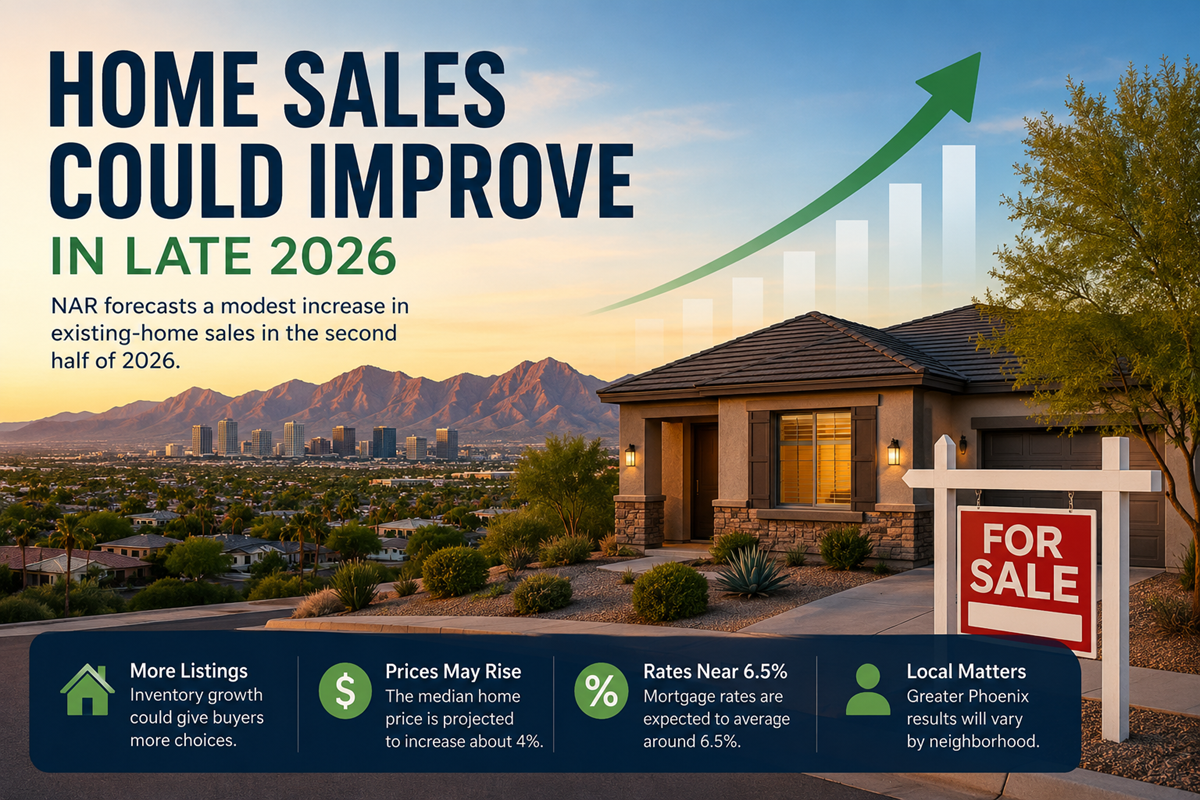
NAR projects existing-home sales to rise 4% during 2026. It also expects the national median home price to increase by roughly 4%. Those figures point to gradual movement, not a sudden market surge. Some cities may post stronger gains. Other areas may stay flat or move slower. National forecasts set a broad direction, while neighborhood data tells you what’s happening near your home.
- Existing-home sales could rise 4%
- Median prices could rise 4%
- Results may differ by city
- Neighborhood trends remain local
- Forecasts can change
For Greater Phoenix homeowners, the national outlook offers context. Your subdivision, price range, property type, & listing condition will still shape the outcome.
Mortgage Rates Still Set The Pace
Financing remains one of the main forces in the 2026 housing market. NAR projects mortgage rates to average about 6.5% this year. A small rate shift can change a buyer’s monthly payment & price range. That can affect which homes receive offers. It can also change how long a listing stays active. Buyers should focus on the full payment rather than a headline rate alone.
- Rates affect monthly housing costs
- Payments shape buyer price ranges
- Taxes add to the total
- Insurance costs matter
- Loan terms can differ
No one can call every rate move. Buyers can prepare by reviewing payment ranges, while sellers can study what nearby buyers can afford.
Homeowners May Keep Building Equity
NAR estimates that a typical homeowner could gain about $16,000 in housing wealth during 2026. That estimate comes from projected home-price growth across the country. It won’t apply equally to each property. A home’s location, condition, size, & recent nearby sales can move its value in another direction. Still, the estimate shows why long-term ownership remains part of the housing discussion. Equity often grows in quiet steps.
- Equity gains won’t match each market
- Property condition can affect value
- Nearby sales guide estimates
- Ownership costs still count
Paper equity also isn’t cash in your pocket. You usually access it through a sale, refinance, or loan, each with its own costs.
Buyers Are Still Finding Ways To Purchase
The market may feel stuck, yet transactions continue. NAR research points to several buyer groups making purchases despite high borrowing costs & limited affordability. Some buyers have equity from a prior home. Others have saved longer or adjusted their search. First-time buyers may also need less than the widely assumed 20% down payment. NAR reported that the typical first-time buyer put down 10% last year.
- Some buyers bring sale proceeds
- Others adjust their target area
- Down payments vary by loan
- Preparation can reduce delays
- Each purchase has its own math
You don’t need to copy another buyer’s plan. A lender can show how different loan structures affect your payment, cash needs, & long-term costs.
Read More: Paradise Valley Ranked Among America’s 10 Priciest ZIP Codes

Greater Phoenix Will Follow Its Own Pattern
A national forecast can’t describe each part of Greater Phoenix. Housing conditions can shift from one ZIP code to the next. Entry-level homes may attract a different response than higher-priced properties. Condos may follow another path. New construction can also affect nearby resale activity. That’s why local sales, active listings, price changes, & days on market deserve close attention. Broad reports start the conversation. Local numbers finish it.
- Check recent neighborhood sales
- Review active listing competition
- Track price reductions
- Compare similar property types
The outlook gives buyers & sellers a reason to watch the second half of 2026. It doesn’t call for a boom. It points to a market that may loosen as inventory grows & more households find a workable path forward.
Keep The Forecast In Perspective
Positive housing news can sound bigger than it is. This forecast calls for improvement, yet the expected gains remain modest. Mortgage costs can still limit budgets. Prices can still strain buyers. Sellers may face more competition as inventory expands. The next several months may bring progress without bringing easy deals. That’s a fair reading of the report.
- Improvement doesn’t mean a frenzy
- Buyers still need clear budgets
- Sellers still need sound pricing
- Local data should guide decisions
We shall wait and see.
Read More: Arizona Is Holding Up Better Than Many States On Foreclosures


